I remembered who I used to be

Once upon a time I was immersed in the world of birth, babies and midwifery. I first became pregnant in the winter of 1991 and the pregnancy marched alongside the MA in Local History that I was undertaking at the time. The bump and I researched the isolation of Cumberland, the evocation of place in Greenwood’s Love on the Dole, church architecture, village morphology, how to read secretary hand and how to decipher probate inventories and wills. My dissertation was on the decline of Stourbridge fair – one of the biggest trading fairs in Europe which took place in Cambridge every autumn until the 1930s.
When the bump became a baby I turned my attention to breastfeeding, attempted routines and the elusive full nights sleep. But I was still an historian and casting round for a PhD subject (turns out looking after a baby wasn’t all-consuming) I settled on a history of birth and midwifery. My research focused on Sheffield, where I was living and studied. I trawled secondary literature and archives, tramped the streets, transcribed and number crunched. By the time I was awarded my PhD in 1997 I had three children and no job. Casualisation in the university sector is nothing new but sits uneasily with a mortgage and three small people. My community midwife, who was there when my youngest was born at home suggested I train to be a midwife. Mavis Kirkham, doyenne of feminist midwifery and professor at the university also told me that I should do the training; although she warned me that I’d hate it.
I did do midwifery training in Sheffield, working there and then in Nottingham. I left clinical midwifery in 2008 and became a lecturer in midwifery… with a sideline in historical research. I moved to the University of Brighton as a Principal Lecturer in 2014, and left midwifery and academia 10 years later.
Everything about midwifery annoyed and exhausted me. The rules and rituals, the hierarchies, the rigidities, the petty cruelties, the stupidity. The fact that midwives were both over-conscious of their history and not conscious enough. There was no nuance anywhere. Midwife led ‘social models’ of birth were good, doctor led ‘medical models’ were bad. Women were nowhere in the battle of the professions. But in reality, everything is nuance, everything is grey areas. Ultimately everything is pragmatism not dogma. But there seemed to be no room for that. The cognitive dissonance of teaching one thing and knowing that students were experiencing something very different in practice became overwhelming.
When I left midwifery in 2024, I didn’t look back. I left most of my books behind (keeping only the historical ones). I moved on.
And then. I was planning a piece of weaving for an exhibition call with the theme ‘shelter’. I had originally thought about a womb but didn’t do anything with it and life got in the way. When I came back to it, I had forgotten the womb. I tried to make a bed and a lamp (disaster – see last blog). I made a row of terraced houses. Pretty, but twee. And then I remembered two things:
1. Not all my work has to be weaving
2. The womb!!!!
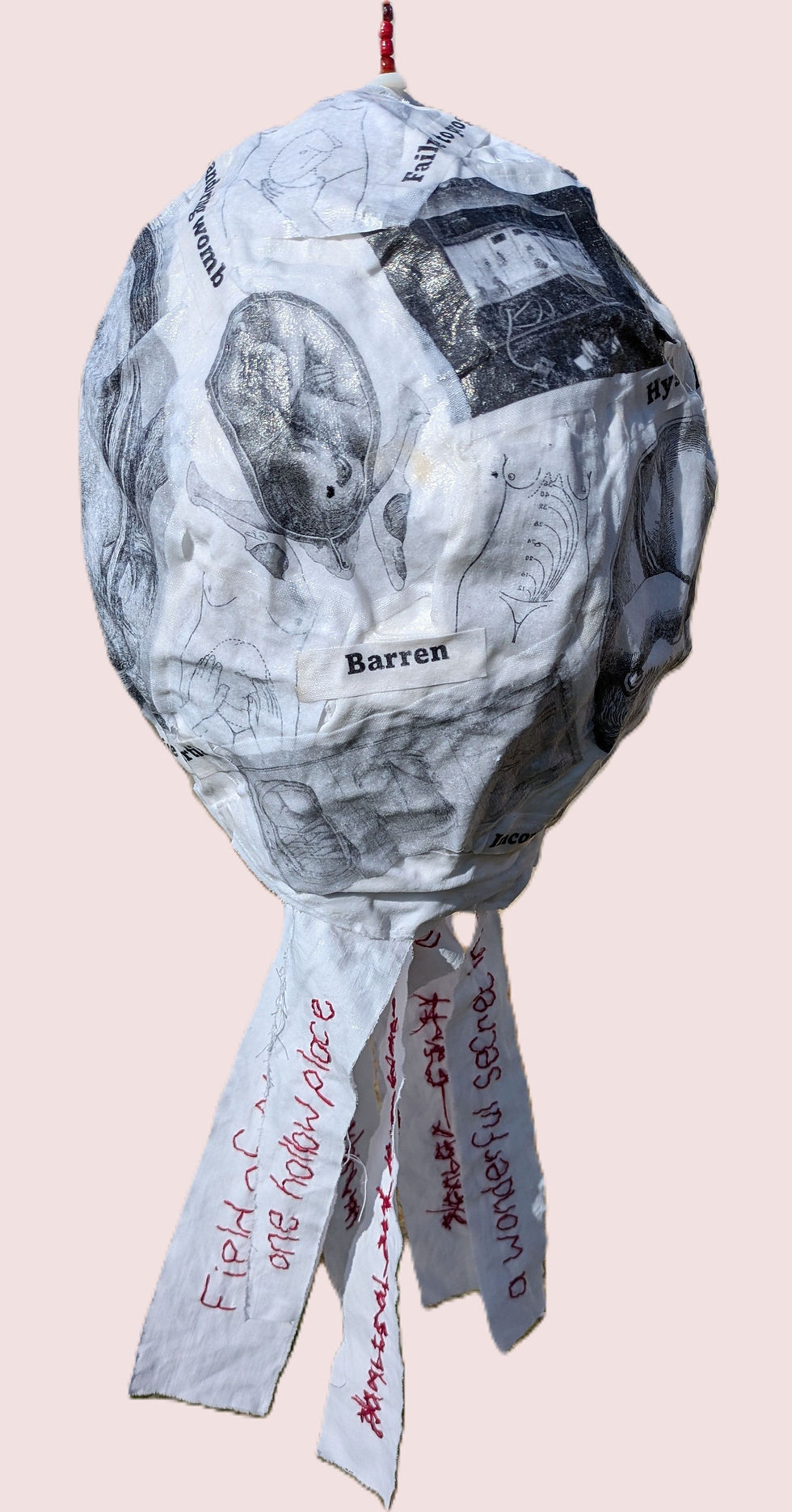
I found an old white midwifery delivery gown from the 1960s (the cotton quite fragile) and used it to make my fabric mache balloon. I then stitched onto lengths of the fabric with a deep red thread. The red stitching is women’s words, from their diaries, letters and women authored textbooks. They wrote about the sanctuary and sanctity of the womb. It was a place of secrecy and safety, away from prying eyes and hands. On the dried fabric mache womb, I stuck pictures and phrases, which I had transferred onto an old midwifery draw sheet. These pictures and phrases I took from male authored textbooks dating from the 19th and 20th centuries. They demonstrate how ‘desperate’ doctors were to see inside the womb, to stop having to trust women, and how that place of safety was increasingly judged as useless if not downright dangerous. There started the medicalisation of birth – the professional male gaze. Once doctors could see inside, with pinards, ultrasound, x-rays and fetal monitoring, they could control pregnancy and birth. They no longer had to listen to women. Now they could tell women their date of conception, of expected birth, how many babies they carried, which way up they lay. Doctors took on the (self-appointed) role of champion of the fetus. They set up its needs and rights as superior to the women that nurtured them; now reduced to the status of vessels.
I used to write about this kind of stuff all the time; trying to root contemporary practice in its historical context. But I’ve never attempted to make art from it before. It reminded me how much I still care.


Dear Tania,
Hello, this is Tam from LWDW foundation death doula course. This article is so fascinating and moving. The art you created with an old 1960s midwifery gown as its base material and starting point is just… it’s moved me deeply. As a fellow (extremely amateur!) artist i salute you. Especially the way you can weave (see what I did there 😊) your historian and academic background and your feminism into your ex role as a midwife, midwifery academic and mother, into your work as an artist. Wow. Just wow. Am feeling awe. And in reaction to “male gaze” writings and reclaiming of tension gaze in this beautiful piece, felt a wee tear in my eye. Sending you much…