Shape-shifting
Right at the beginning of my tapestry weaving life, I decided to weave a terraced house. I can’t quite remember how or why I decided that it was a good idea, but I’ve always loved vernacular architecture of all types, and the Victorian terrace is a definite favourite[1]. I seem to remember that I thought that it would be a handy way to consolidate my learning around soumak, half passes, sewing slits, that type of thing. So I planned a Victorian terrace, possibly a row. Then, when I was faffing around at my weaving class, warping my loom and trying to choose weft, my wonderful tutor (Clare) started chatting to me about my plans. Either I didn’t explain it very well, or I made it sound very boring, but she suggested I make a 3-D house. At first, I thought she meant showing its depth on a flat surface, but she did actually mean 3-D. Well, that was a challenge I could not resist!
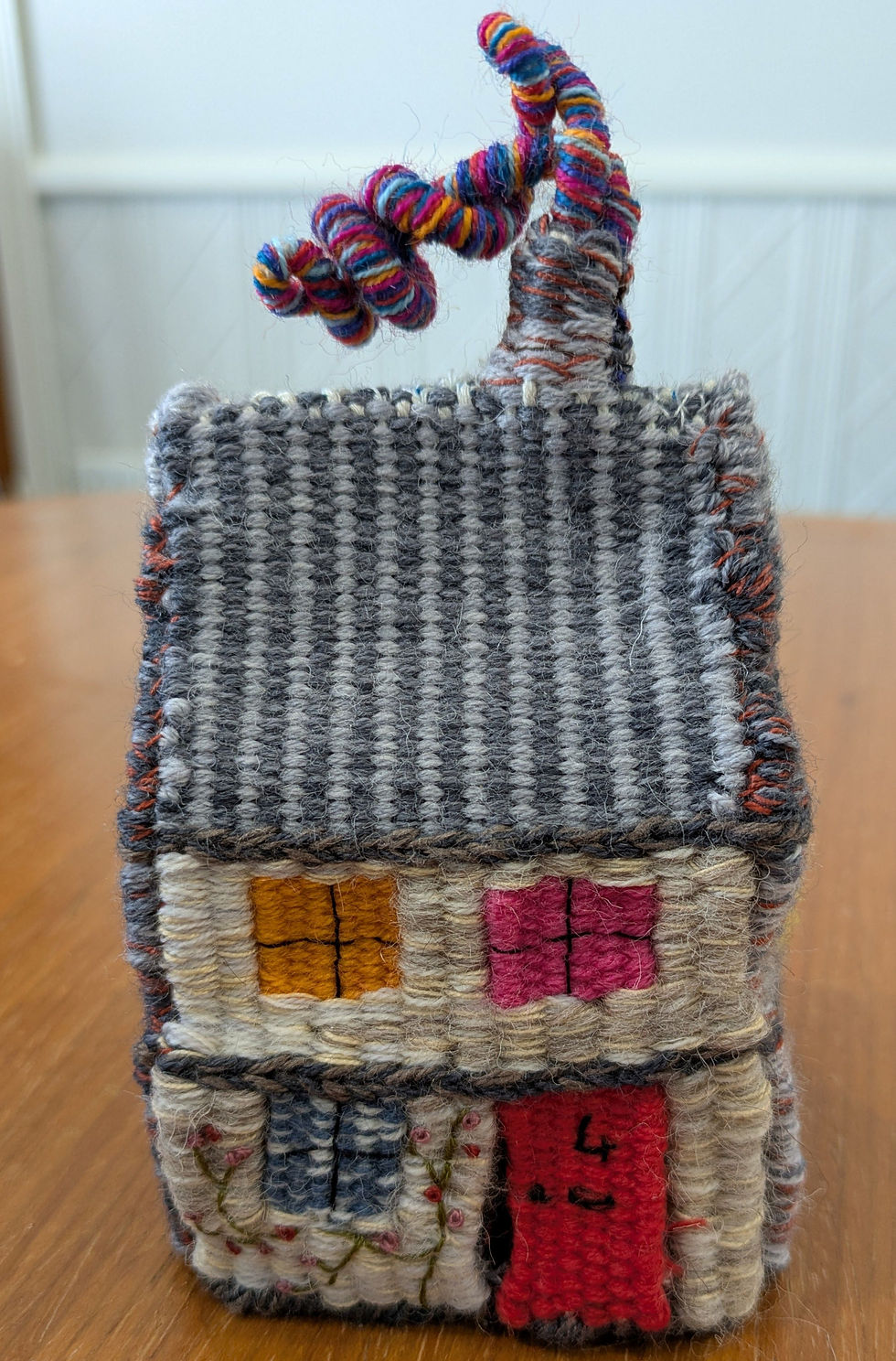
The challenge was not in the weaving but in the planning. I have since discovered that this sentence is all you need to know about weaving – it is ALL in the planning. Once the decisions are made about size, material, colour, production, making the thing can seem easy (although always surprising… you never really know if a plan has worked, or at least morphed into something else, until its off the loom). I made the house in two halves (front and side, back and side) and then sewed them together afterwards – I could have done them as one piece but that would have meant weaving sideways to give me enough length and I felt I had enough going on. I drew lots of plans but in the end, when it came to the roof, the only way I could get my head around what I needed to weave was to make a 3-D paper model. I realised that for the roof sections above the front and back of the house, I could just make rectangles (using half passes in two different shades of grey to give a sense of roof slates). However, the sides of the houses needed to have triangular roof sections – which I made in mottled browns to mimic bricks. The front of the house I made in a pale beige to look like the stone fronts of the houses I used to live in in Sheffield.
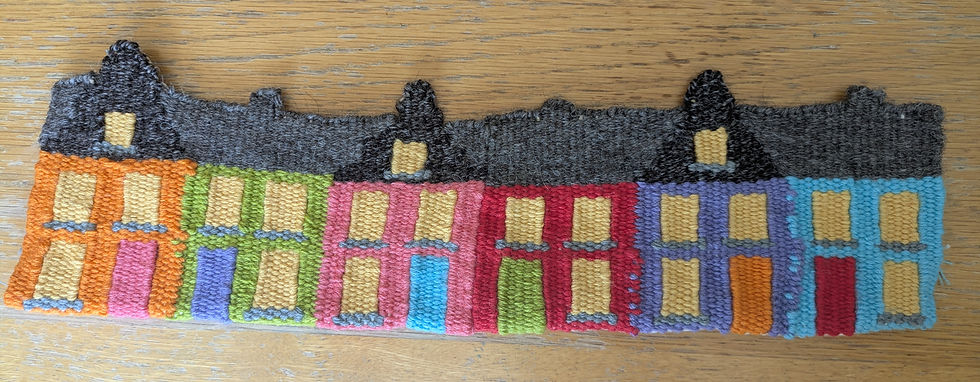
I was really pleased with the outcome but then didn’t develop it. I got stuck into all sorts of other ideas and projects and the little house stood on the shelf in our kitchen. The weaving I have done since then has all been variations on the theme of ‘flat’. This is, I suppose, how weaving should be. It was developed primarily as a wall-hanging; not as a framed ‘picture’ and certainly not as a shape. I even made a row of terraces – flat.
But for some reason, over the last hot weeks of summer, I have been drawn again to the ideas of dimensions in weaving, and how something necessarily made flat can be manipulated into objects that can be held and viewed from different angles. I knew, from having seen pictures in books (and from my knowledge as a home sewist), that cut outs or gores are the answer to creating most shapes. The cut outs leave exposed warp between sections which can then be pulled tight to bring the weft sections together and create shape.
I made a bean.
Then a bowl.
Then I tried to leave out triangle sections. The results were never entirely what I expected – things pulled differently, came together differently. I’ve not yet managed to create a neat curve. I need to continue to play with warp and weft thickness, I think. But the triangle gores give a different style of eccentric weaving and I want to explore this further as a way of producing ‘textured’ landscapes. I’ve also been surprised (I don’t know why!) by how pulling warps tightly creates a new texture in the finished piece. The bowl I made had the textured of a felted piece and I bet that it would hold water (I haven’t yet tried). Using cotton warp and wool weft pulls together to create objects with real structural integrity and strength.
My creations so far have been tiny. I am conscious of summer slipping by and new things on the horizon so I didn’t want to start big pieces that would take lots of time and material (and be exponentially more disappointing if they failed completely). But I do think that working in 3-D is an area to which I will definitely return.
[1] It’s always important I feel to have answers to the important questions that get asked in life: favourite type of English house (terrace), favourite era of women’s fashion (1910-18), favourite pre-Roman era (Iron age), favourite Tory prime Minister (Disraeli), favourite Labour Prime Minister (Attlee), favourite Victorian recipe (toast water), favourite diarist (Pepys), favourite midwifery Act of Parliament (1936 Midwives Act) and so on…


Comments