On sketching and sampling
One of the thrills of learning tapestry weaving has been the organic movement from working with straight lines to attempting shapes. These started as slopes and squares, progressed to triangles and ‘circles’ (the speech marks are to be clear that although I might describe a particular woven shape as a circle, it bears no resemblance to something you might draw with a compass or even sketch with a pencil. It is just a square with attitude). I will now attempt most shapes depending on what my work needs and I have a definite soft spot for eccentric weaving and the gentle forms that it can create.
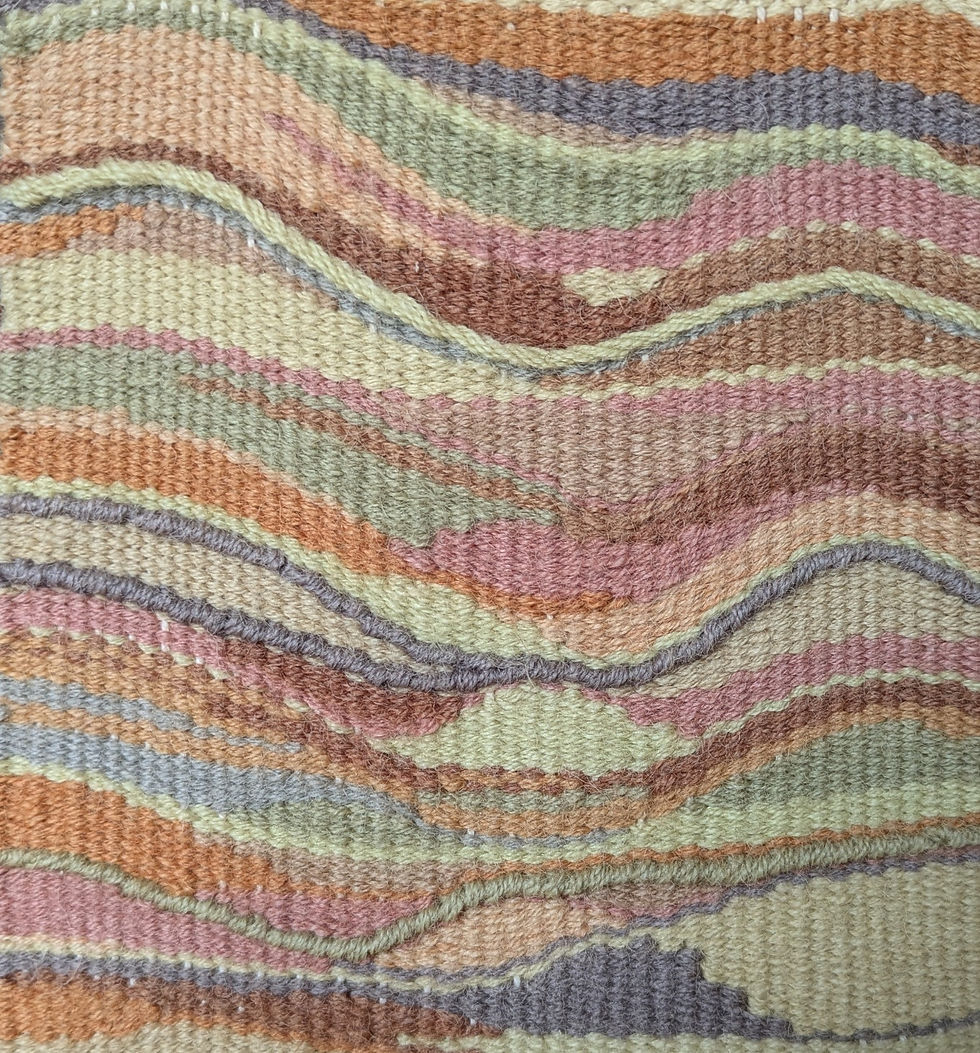
Most of the weaving I do is born of sketches I have made. Once I might just have dived in, but I have learned the value of drawing, refining, simplifying, redrawing before I even consider warp or weft. I have found looking at the work of print-makers particularly valuable in encouraging me to look beyond the messy reality of a scene, and to focus on its essence. I don’t mean anything clever by this, simply that I can’t weave a landscape in its totality. If I want everything, I just take a photo. But something in the landscape or scene draws me in, even if I can’t immediately work out what it is. Initial sketches help me to focus on what I feel is significant to me. I will then refine these sketches to become workable (weaveable) blueprints. As time goes on, I loop back to my ideas and they become more abstract. I think I do this to create a plan, to pull out what matters but also for more nebulous reasons – something to do with what I feel is the heart of the matter. Again, the way that print makers tessellate abstract shapes to create a scene I find very inspiring.
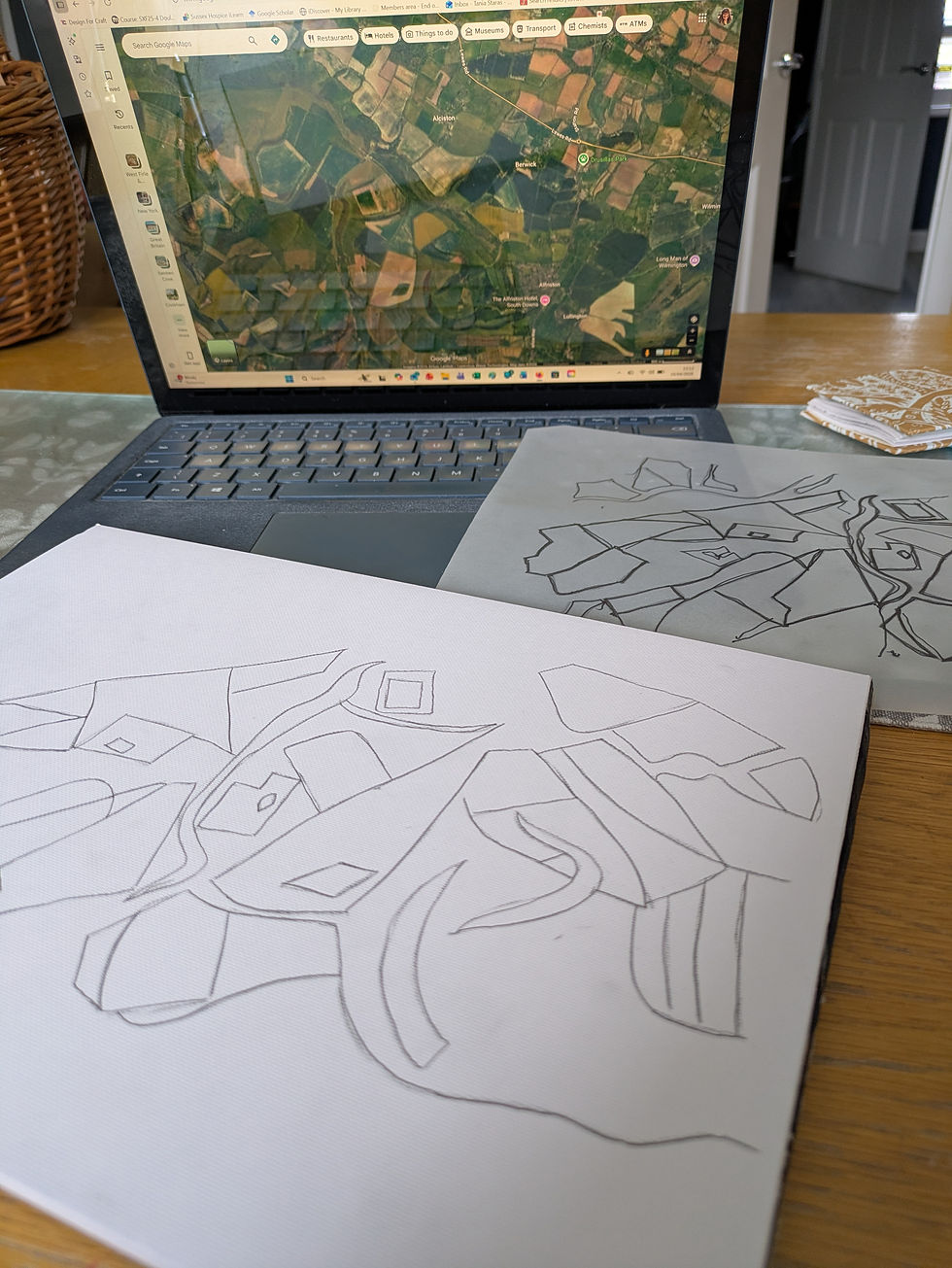
So far so good. I sketch because I enjoy it and I can see the value of it in my weaving. I love messing around with pencils, pens or water colours. I love manipulating colours – why not have a pink sea, orange trees and a green sky? I feel like a kid, making without rules. As to the value of it, well I have learned to appreciate and even love a good cartoon. Without sketching there are no cartoons and without cartoons there is no workable plan for size, shape, proportion or form. Having said that, I tend not to fix my cartoons carefully behind my weaving. Maybe it’s my fault for not having found the fixing method that works well for me. Pins, magnets and stitches all slither. And besides who follows a cartoon slavishly…? I want the freedom to design and build, adjusting as I go (sometimes accidentally, sometimes on purpose). If I need a hard stop I draw directly onto the warp.
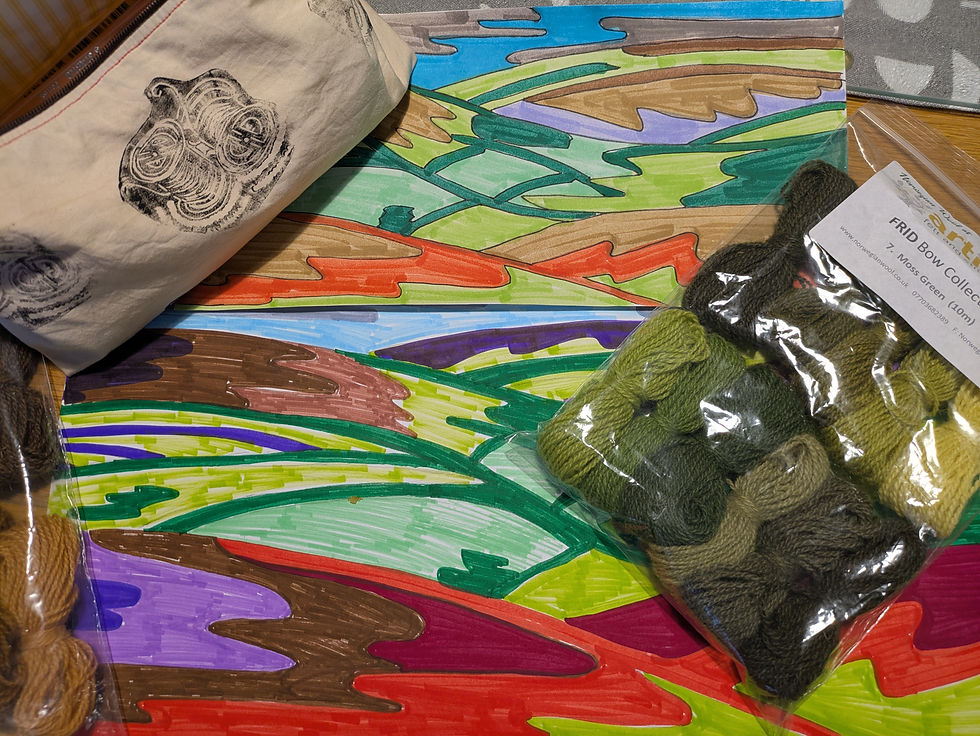
So. I clearly believe in planning, or at least in the idea of turning a thought or picture into a workable plan. All good and pretty sensible. But I do it because I enjoy the process. If I didn’t then I suspect I wouldn’t bother so much. What I actively dislike is…
SAMPLING.
For a lot of weavers this is an essential part of the process. Without sampling, how will you know which warp, which weft, what sett, what colours… everything really that makes a weaving successful. After all, it’s daft to do all that sketching and then to leave out the practical side of the planning. You run the risk of getting the proportions wrong, a yucky colour mix, or even not having enough of your materials. Sensible. Logical – as I type this, I know it makes sense. But I still can’t bear to do it unless I absolutely have to.
Right.
Reasons for not sampling:
· Cost. I don’t have much money. Unless I’m going to pull out and reuse all my materials than I can’t afford to waste valuable weft (especially) on fiddling about on a small scale. If I’m working on the actual piece and I don’t like the colours then I will take them out and reuse or add different shades into the mix as I go.
· Time. Its time consuming to sample – even a small sample requires putting on a warp and weaving a reasonable section (enough to get an idea of colour, sett, etc etc, otherwise it’s a total waste of time). I don’t have much time – I have other commitments and so when I weave, I want it to count.
· Its boring. Oh yes, it’s boring – I try to be good and end up wondering why on earth I’m bothering. To me it feels pointless. I suspect this could be because I tend to weave on a smallish scale anyway so nothing can go that awry. I have watched in awe at the level of complexity of the sampling for commissions that goes on at the West Dean tapestry weaving studio. But it makes sense. Yes, they are sampling the design but also working out the likely totals of materials needed and the total time needed and therefore costs. They are exploring colour matches to original complex designs in different media. They are scaling up – a small painting might become a 4 metre by 3 metre tapestry. It has to be right. Whereas as my work is referencing only my rough sketches, can shift and mutate as I work and can be led by the material, rather than the material having to replicate a design.
· I’m too slapdash. Am I in too much of a hurry, not able to commit fully to the process? I know that I’m not a perfectionist; my whole life runs on the motto of ‘that’ll do’. Sometimes I end up with something better or different to what I expected and I'm happy with that. I’m happy with the outcome being fluid and with the idea of flexibility or change as I work. I like to think that I’m working in partnership with the material, not forcing it down my preordained paths.
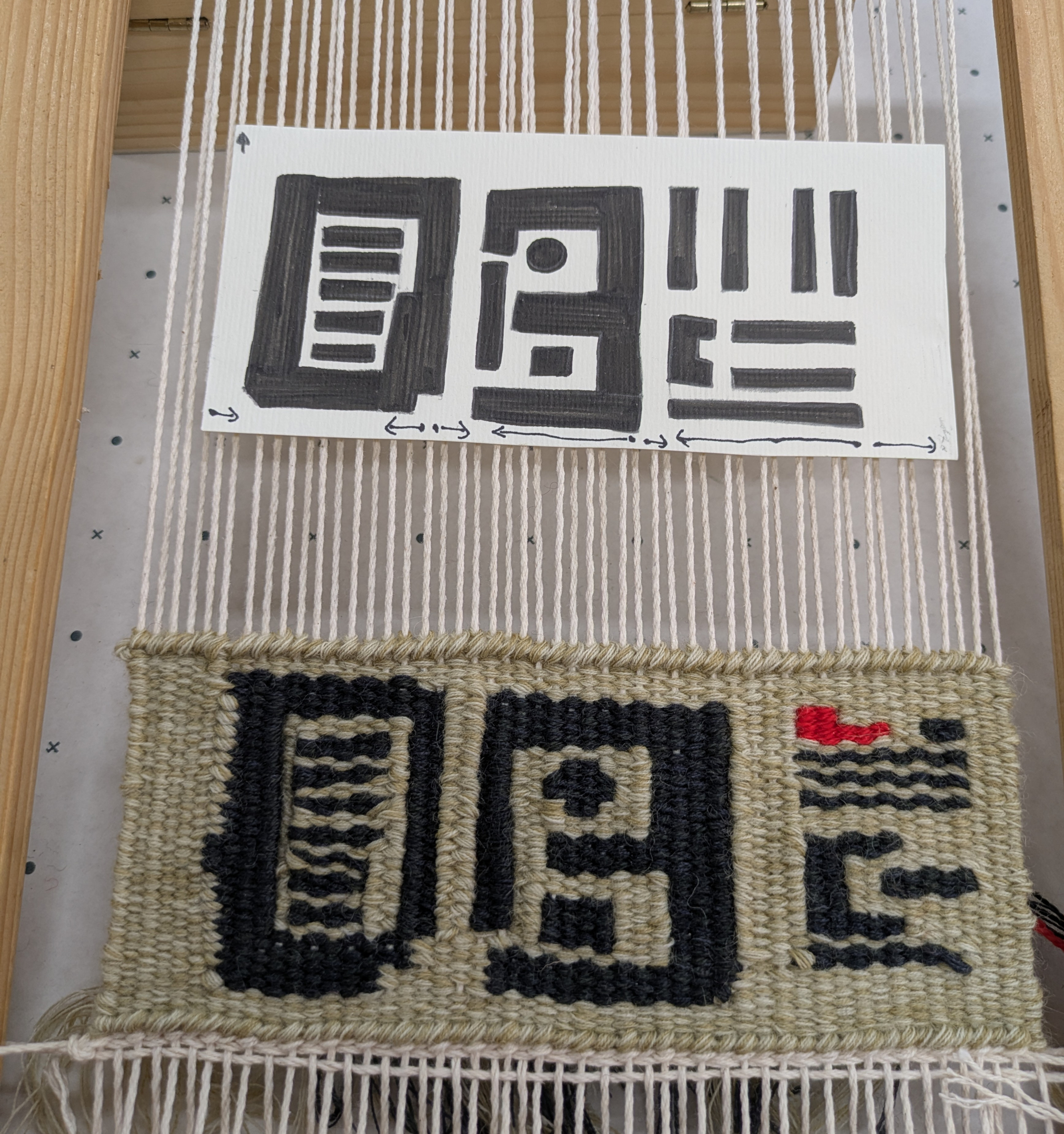
Maybe as my work gets grander or more complex, I will take to sampling. Meanwhile I shall admire others commitment to the cause (and their results) whilst continuing to ‘hit and hope’ in my own work.


You know yourself well, and at least you are consistent - how many tension squares have you knitted in your life???